2026 മാർച്ച് 16, തിങ്കളാഴ്‌ച

Pope Francis’ historic appointments: 4 women helping to lead the Vatican

Throughout his papacy, Francis took steps to appoint and integrate women into leadership roles in the Vatican.
Religious sisters gather to pray the rosary for Pope Francis in St. Peter’s Square at the Vatican, Monday, April 21, 2025. | Credit: Daniel Ibáñez/CNA
Kate Quiñones
April 25, 2025 at 10:45 AM ET Throughout his papacy, Francis took steps to appoint and integrate women into leadership roles in the Vatican. From the time he took office in 2013, the number of female employees working in the Vatican increased from about 850 at the beginning of Francis’ papacy to nearly 1,200 in 2023, according to a report by Vatican News.

As of 2023, more than 1 in 4 employees of the Roman Curia — the group of bureaus that support the pope in governing the Church — are women.

While increasing the opportunities for women in the Church, Pope Francis consistently maintained the Catholic teaching that the priesthood is reserved for men. Francis said the Church needed to preserve its masculine “Petrine principle” in regards to ministry as well as its feminine, spousal nature, which he called the “Marian principle.” Notably, Francis believed women were highly capable of participating directly in the Church, especially in an “administrative way.” He said women make better managers than men and “have been running things since the Garden of Eden.”

In a 2022 interview, Francis spoke of the dignity of women as reflecting the spousal, feminine nature of the Church.

“A Church with only the Petrine principle would be a Church that one would think is reduced to its ministerial dimension, nothing else,” he said. “But the Church is more than a ministry. It is the whole people of God. The Church is woman. The Church is a spouse. Therefore, the dignity of women is mirrored in this way.”

In March 2022, the pope established in Praedicate Evangelium (“Preach the Gospel”) that any member of the faithful could be eligible to lead a Vatican dicastery.

Women became voting members in a 2023 synod for the first time in the Church’s history. The pope also opened to women “full membership” roles in the Vatican dicasteries — previously reserved for cardinals and bishops. In January, Pope Francis marked another milestone in his pontificate by appointing Sister Simona Brambilla, the first-ever woman to head a Vatican dicastery — the Dicastery for Institutes of Consecrated Life and Societies of Apostolic Life.

As the Church reflects on Francis’ legacy and the confidence he placed in women to help lead the Church, CNA took a closer look at four religious sisters appointed to some of the highest-ranking leadership roles in the Vatican.

EWTN Logo

Pope Francis’ historic appointments: 4 women helping to lead the Vatican

Throughout his papacy, Francis took steps to appoint and integrate women into leadership roles in the Vatican.

Pope Francis’ historic appointments: 4 women helping to lead the Vatican
Religious sisters gather to pray the rosary for Pope Francis in St. Peter’s Square at the Vatican, Monday, April 21, 2025. | Credit: Daniel Ibáñez/CNA
Kate Quiñones
April 25, 2025 at 10:45 AM ET

Throughout his papacy, Francis took steps to appoint and integrate women into leadership roles in the Vatican. From the time he took office in 2013, the number of female employees working in the Vatican increased from about 850 at the beginning of Francis’ papacy to nearly 1,200 in 2023, according to a report by Vatican News.

As of 2023, more than 1 in 4 employees of the Roman Curia — the group of bureaus that support the pope in governing the Church — are women.

While increasing the opportunities for women in the Church, Pope Francis consistently maintained the Catholic teaching that the priesthood is reserved for men. Francis said the Church needed to preserve its masculine “Petrine principle” in regards to ministry as well as its feminine, spousal nature, which he called the “Marian principle.” Notably, Francis believed women were highly capable of participating directly in the Church, especially in an “administrative way.” He said women make better managers than men and “have been running things since the Garden of Eden.”

In a 2022 interview, Francis spoke of the dignity of women as reflecting the spousal, feminine nature of the Church.

“A Church with only the Petrine principle would be a Church that one would think is reduced to its ministerial dimension, nothing else,” he said. “But the Church is more than a ministry. It is the whole people of God. The Church is woman. The Church is a spouse. Therefore, the dignity of women is mirrored in this way.”

In March 2022, the pope established in Praedicate Evangelium (“Preach the Gospel”) that any member of the faithful could be eligible to lead a Vatican dicastery.

Women became voting members in a 2023 synod for the first time in the Church’s history. The pope also opened to women “full membership” roles in the Vatican dicasteries — previously reserved for cardinals and bishops. In January, Pope Francis marked another milestone in his pontificate by appointing Sister Simona Brambilla, the first-ever woman to head a Vatican dicastery — the Dicastery for Institutes of Consecrated Life and Societies of Apostolic Life.

As the Church reflects on Francis’ legacy and the confidence he placed in women to help lead the Church, CNA took a closer look at four religious sisters appointed to some of the highest-ranking leadership roles in the Vatican.

First-ever woman to lead a dicastery

In January, Sister Simona Brambilla became the first woman to head a Vatican dicastery.

As prefect of the Dicastery for Institutes of Consecrated Life and Societies of Apostolic Life, she oversees about 700,000 religious men and women throughout the world.

Brambilla, 60, is a member of the Consolata Missionaries religious order and served as superior general of the order for more than a decade. She was a missionary sister in Mozambique in the late 1990s and as a professional nurse taught at the Pontifical Gregorian University in its Institute of Psychology.

Cloudinary Asset

Pope Francis greets Sister Simona Brambilla, superior general of the Consolata Missionary Sisters, in Clementine Hall, June 5, 2017, at the Vatican. Credit: L'Osservatore Romano

Pope Francis appointed Brambilla in December 2024 as a member of the Ordinary Council of the General Secretariat of the Synod, which helps prepare the ordinary general assembly of the Synod of Bishops. In July 2019, she — alongside six other women — became the first female members of the Dicastery for Institutes of Consecrated Life and Societies of Apostolic Life. She later became secretary of the dicastery.

When asked about her appointment as secretary in a 2024 interview, Brambilla said that for peace to grow, it “needs the fertility of a primordial soil: the healthy, good, trusting, respectful, reverent, tender, and vital relationship between man and woman.”

“A bit as it must have been at the beginning of time, in that garden in which God loved to walk in the breeze of the day, looking for the man and the woman, his blessed image,” Brambilla said.

Brambilla works with a cardinal who serves as pro-prefect, an unprecedented structure in the Holy See. Church law calls for ordination to carry out certain governing powers.

Pope Francis made it possible for laypeople including women to lead a dicastery — a role previously reserved for cardinals and archbishops — in the apostolic constitution Praedicate Evangelium in 2022.

Vatican City’s first female governor

At the beginning of 2025, Pope Francis appointed Franciscan religious sister Raffaella Petrini as president of the Pontifical Commission for Vatican City State and governor of Vatican City State, making her the first woman to ever hold the position.

Petrini served as secretary of both institutions since November 2021 — a second-ranking role in which she oversaw administrative offices, the police department, museums, and other services in Vatican City.

Cloudinary Asset

Sister Raffaella Petrini meets Pope Francis. Credit: Vatican Media

In her new role, Petrini reports directly to the pope and manages the Vatican budget and finance. As president of the Governorate of Vatican City, she runs the executive body of the papal city and leads the pontifical commission. She is the legislative authority of the city state. The governorate encompasses security and public order, health, economic issues, and infrastructure as well as the Vatican Museums and the Pontifical Swiss Guard.

Petrini, a member of the Franciscan Sisters of the Eucharist, replaced Cardinal Fernando Vérgez in the role beginning on March 1.

Petrini, 56, is a professor with both academic and administrative experience. She was born in Rome on Jan. 15, 1969, and graduated with a degree in political science from the Guido Carli International University of Studies. She has a doctorate from the Pontifical University of St. Thomas Aquinas in social sciences, where she has taught economics and the sociology of economic processes.

From 2005 to 2021, Petrini worked at the Congregation for the Evangelization of Peoples, which was responsible for missionary work.

Pope Francis announced Petrini’s appointment in January during an interview, where he said: “Women know how to manage things better than us” and shared how “we now have many women” in leadership roles in the Vatican.

Pioneering woman in key social development role

In August 2021, Pope Francis appointed Italian economist and Catholic religious sister Alessandra Smerilli to a second-ranking position in the Vatican’s social development office — one of the highest posts ever held by a woman at the Holy See.

Smerilli, a Salesian Sister of Don Bosco, was appointed “ad interim” secretary of the Vatican’s social development office, the dicastery for Promoting Integral Human Development.

The office helps promote Catholic social teaching around the world by addressing various social justice issues including human rights, the safeguarding of creation, human trafficking, and other charitable works.

The 50-year-old Salesian sister is an economist and professor. She has been an undersecretary at the human development dicastery since March 24, 2021, and was one of the principal organizers of the 2020 Economy of Francesco event.

Cloudinary Asset

Sister Alessandra Smerilli is now the secretary of the Vatican Dicastery for Promoting Integral Human Development. Credit: Daniel Ibáñez/CNA

When asked in 2024 by Angelus News about women in leadership in the Church, Smerilli said: “We need both men and women in order to have a more complete picture and a different perspective on the reality we face.”

Since 2019, Smerilli has also served as a councilor of the Vatican City State and a consultant to the secretariat of the Synod of Bishops. In spring 2020, she was asked to coordinate the economic task force of the Vatican COVID-19 Commission.

Forbes’ ‘most influential religious sister’

French religious sister Nathalie Becquart became the highest-ranking woman to ever work in the Synod of Bishops after Pope Francis appointed her to the second-ranking position in February 2021.

Becquart became the first woman undersecretary of the Synod of Bishops, the advisory body to the pope himself. She went on to become the first woman to be a voting member in a Catholic synod, which is usually made up of bishops, priests, and some religious men, and Becquart was among many women who actively participated in the 2023 and 2024 Synod on Synodality.

Becquart holds a master’s degree in entrepreneurship from the HEC business school in Paris. Before she joined the Xavière Sisters at age 26 in 1995, she worked as a marketing consultant.

In 2024, the magazine featured Becquart in its Forbes Most Influential Women “50 over 50” list, calling her “the highest-ranking woman in the Vatican.”

Cloudinary Asset

French Sister Nathalie Becquart, a member of the Congregation of Xavières, in a Feb. 10, 2021, photo four days after being appointed by Pope Francis as undersecretary of the Synod of Bishops. Credit: ALBERTO PIZZOLI/AFP via Getty Images

Because of her extensive background in youth ministry, Becquart was involved in the preparation for the Synod of Bishops on young people, faith, and vocational discernment in 2018 and was general coordinator of a pre-synod meeting, taking part as an auditor.

Before her 2021 appointment, Becquart worked in the Synod of Bishops as a consultant to the general secretariat beginning in 2019. From 2012 to 2018, she oversaw the French bishops’ National Service for the Evangelization of Youth and for Vocations, a program designed to evangelize young people and cultivate a culture of vocations.

https://www.ewtnnews.com/vatican/pope-francis-historic-appointments-4-women-helping-to-lead-the-vatican?utm_source=perplexity&redirectedfrom=cna

Pope Francis approves reforms granting women the right to vote at bishops’ meetings

Pope Francis Wednesday approved historic reforms granting women the right to vote in the Synod of Bishops, an assembly of bishops from around the world which gathers regularly to discuss Church matters and advise the Pope. The move reflects continued pressures the Pope has faced to grant women greater representation within the Roman Catholic Church, and to expand inclusivity within the Holy See.

The changes call for the appointment of 70 “non-bishop members” to hold voting status at the Synod, which next meets at the October 2023 General Assembly. Of those 70 members, half will be women, and the presence of young people will also be emphasized, an edict which the Bishops presenting the reforms explained existed “because that is the way our world is.” The 70 members will be appointed by the Pope from a list of 140 individuals, prepared by the 7 International Reunions of Bishops’ Conferences and the Assembly of Patriarchs of Eastern Catholic Churches.

Church officials stressed that the reforms were “not a revolution but an important change,” and noted that bishops remain the majority presence in the Synod. With that being said, the changes undoubtedly reflect a shift in the attitudes of the Church, which has received sustained calls to form a more inclusive Synod.

“This is a significant crack in the stained glass ceiling,” wrote Catholic Women’s Ordination, a UK-based feminist group seeking gender equity in the Roman Catholic Church. They continued:

“In the near future, we hope that the synod continues to develop into a fully representative body of the people of God. This is an important step on the path toward gender parity, and we will continue our persistent efforts to work for lasting structural changes in the church.”


https://www.jurist.org/news/2023/04/pope-francis-approves-reforms-granting-women-the-right-to-vote-at-bishops-meetings/?utm_source=perplexity

Synod: Laymen and laywomen eligible to vote at General Assembly

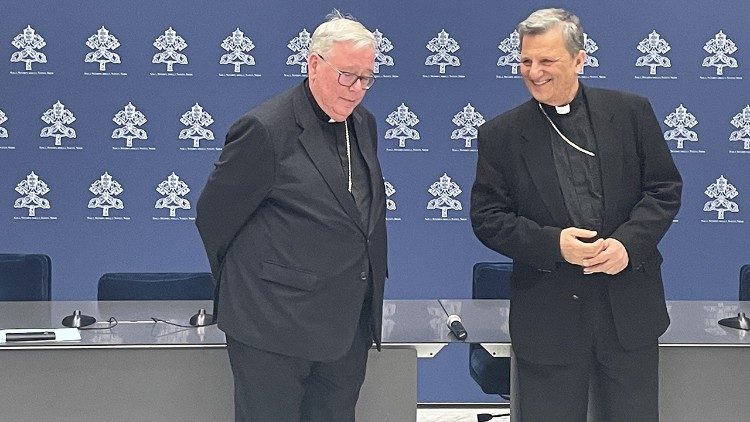
Cardinals Hollerich (L) and Grech (R) present the changes to the Synod at the Holy See Press OfficeCardinals Hollerich (L) and Grech (R) present the changes to the Synod at the Holy See Press Office 
Vatican

Synod: Laymen and laywomen eligible to vote at General Assembly

The Secretariat for the Synod announces that 70 “non-bishop members” appointed by the Pope—half of whom will be women—will be able to vote at the Synod General Assembly in October.

By Salvatore Cernuzio

Neither the nature nor the name is changing—which remains the Synod of Bishops—but the composition of the participants in the October 2023 General Assembly in the Vatican on the theme of synodality is set to change, since a sizeable group of "non-bishop" members will also take part.

These 70 individuals will include lay people appointed directly by the Pope, 50 percent of whom shall be women and among whom shall be included several young people. All 70 will enjoy voting rights at the Assembly, which will consist of around 370 voting members out of more than 400 total participants.

‘Not a revolution’

These represent the main changes introduced on Wednesday by Pope Francis for the Synod Assembly, which will seal the synodal path he himself launched in the Autumn of 2021.

The changes were presented by Cardinal Mario Grech, Secretary General of the Secretariat for the Synod, and Cardinal Jean-Claude Hollerich, the Synod’s General Relator.

“This is not a revolution but an important change," they specified at a press conference at the Holy See Press Office on Wednesday.

"Non-bishop" members

The new arrangements were communicated on the same day in a letter to the heads of the Continental Assemblies held recently in Africa, Asia, the Middle East, and Oceania.

The letter states that no current regulations have been repealed, and that the 2018 Apostolic Constitution Episcopalis Communio already provided for the presence of "non-bishops" at the Synod.

The 70 non-bishop members will be chosen by the Pope from a list of 140 prepared by the 7 International Reunions of Bishops' Conferences and the Assembly of Patriarchs of Eastern Catholic Churches.

They shall represent “various groupings of the faithful of the people of God (priests, consecrated women, deacons, lay faithful)”, according to the letter.

The Synod Assembly shall also no longer include “auditors”.

A "plenary" assembly of bishops

“In this way, the specifically episcopal nature of the Synodal Assembly is not affected, but is rather confirmed," the General Secretariat of the Synod’s letter emphasizes.

"We are talking about 21 percent of the Assembly remaining a plenary assembly of bishops, with a sizable participation of non-bishops," Cardinal Hollerich reiterated further. "Their presence ensures the dialogue between the prophecy of the people of God and the discernment of the pastors."

Election and appointment

Speaking about the requirement for half of the 70 to be women and the presence of young people, the Cardinals said this is so “because that is the way our world is."

The choice of the 140 candidates, they added, shall take into account each person’s general culture, prudence, and knowledge and participation in the synodal process. As members, they have the right to vote.

This aspect is important, noted Cardinal Grech, adding that he hopes someday “we will be able to do without the vote, since the Synod is a discernment, a prayer.”

Five religious women and five religious men

The five women religious and five men religious elected by their respective organizations of Superiors General (UISG, for women religious; and, USG, for male religious) will also be eligible to vote.

These 10 men and women religious replace the ten clerics of the Institutes of Consecrated Life who attended in past Synod Assemblies.

All elections—to be held in plenary assembly and by secret ballot by the respective Synods, Councils and Bishops' Conferences—must be ratified by the Pope, and their names shall not be made public until the Pope confirms their election.

Facilitators

For the first time, the Synod will include several "facilitators".

Cardinal Grech explained that this choice was born from the experience of the Synod study groups, "which showed us that the presence of experts can create a fruitful dynamic."

"There are bishops who have never participated in the Synod, so we need to facilitate the spiritual dimension," Cardinal Hollerich explained.

He also noted that for the first time there will also be bishops from countries that do not have an Episcopal Conference represented at the Assembly. Cardinal Hollerich added that his Archdiocese of Luxembourg is one of them, along with Estonia and Moldova.

In conclusion, the two Cardinals agreed that "the Church will be more complete, and it will be a joy to have her represented in her entirety in Rome."

Thank you for reading our article. You can keep up-to-date by subscribing to our daily newsletter.

Pope Francis appoints a woman for the first time to senior role in the Vatican’s Secretariat of State

Francesca Di Giovanni at the United Nations (Credit: Vatican News)

For the first time in history, Pope Francis has appointed a woman to a senior managerial position in the Vatican’s Secretariat of State. He has named Francesca Di Giovanni, an Italian lay woman, to be the second undersecretary of the secretariat’s Section for the Relations with States, with specific responsibility for the multilateral sector, which deals with intergovernmental organizations at the international level and the network of international treaties.

Born in Palermo, Sicily, in 1953, Ms. Di Giovanni graduated with a degree in law and worked as a notary in the administrative-juridical sector of the International Center of the Opera di Maria (Work of Mary) of the Focolari Movement, of which she is a member. She has worked as an official in the Section for Relations with States of the Secretariat of State since September 1993, the Vatican said when it announced her appointment on Jan. 15.

She has worked in the multilateral sector for the past 27 years, particularly on themes relating to migrants and refugees, international humanitarian law, communications, international private law, the condition of women, intellectual property and tourism.

This appointment opens up new horizons for women in the Vatican. The Section for Relations with States, which is headed by the English-born archbishop Paul Gallagher and has a staff of 55 persons, including 12 women, now has two undersecretaries: Ms. Di Giovanni and the Polish-born monsignor Miroslav Wachowski, who is principally responsible for the sector of bilateral diplomacy.

Ms. Di Giovanni, who speaks English as well as Italian, told Vatican News and L’Osservatore Romano, the Vatican daily, that she was “absolutely surprised” by Pope Francis’ decision to appoint her, but she noted that for several years now there had been discussion of the need to have an undersecretary for the highly sensitive multilateral sector, which differs in various ways from the bilateral sector. She described it as “a new role” and said she hopes to respond fully to “the trust” the pope has put in her by working in harmony with the group that she has been a part of for many years.

Explaining the work of the multilateral sector in the Section for Relations with States, Ms. Di Giovanni said, “It deals with relations relating to the intergovernmental organizations at the international level,” which include organizations like the United Nations, the World Health Organization, the International Telecommunications Union and the International Monetary Fund. It also involves work “on the network of multilateral treaties,” which “are important because they express the political will of states regarding various themes relating to the international common good,” including “development, the environment, the protection of victims of conflicts, the condition of women and so on.”

Commenting on the fact that she is the first woman ever to have such a senior role in the Vatican’s Secretariat of State, Ms. Di Giovanni told the Vatican media, “The Holy Father has taken an innovative decision, certainly, which—beyond my person—represents a sign of attention toward women.” But, she said, “the responsibility is linked to the task rather than to the fact that I am a woman.”

Pope appoints Sr. Simona Brambilla as Vatican's first female prefect

Pope Francis appoints Sr. Simona Brambilla, an Italian-born religious sister from the Consolata Missionaries, as Prefect of the Dicastery for Institutes of Consecrated Life and Societies of Apostolic Life, along with Cardinal Ángel Fernández Artime as Pro-Prefect.

By Vatican News

Sister Simona Brambilla, who will turn 60 on March 27, previously served as the Superior General of the Consolata Missionaries.

Pope Francis appointed her on Monday, the Solemnity of the Epiphany, as Prefect of the Dicastery for Consecrated Life and Societies of Apostolic Life.

She has served as Secretary of the same Dicastery since October 7, 2023, and becomes the first woman to be appointed Prefect of a Dicastery of the Holy See.

Pope Francis also chose Cardinal Ángel Fernández Artime, 65, whom he created Cardinal in the Consistory on September 30, 2023, as Pro-Prefect of the Dicastery.

Sr. Brambilla was the second woman to be appointed Secretary of a Vatican Dicastery, following the 2021 appointment of Sr. Alessandra Smerilli to the Dicastery for Promoting Integral Human Development

She has a background that includes missionary experience in Mozambique. She was a professional nurse before joining the Consolata Missionary Sisters Institute, which she led from 2011 to 2023.

On July 8, 2019, the Pope for the first time appointed seven women as members of the Dicastery for Institutes of Consecrated Life and Societies of Apostolic Life. Later, Sr. Brambilla was first chosen as Secretary of the Dicastery and now as Prefect.

Since the beginning of Pope Francis's pontificate, the presence of women in the Vatican has increased. According to overall data covering both the Holy See and Vatican City State from 2013 to 2023, the percentage of women has risen from 19.2% to 23.4%.

A pathway outlined by the Apostolic Constitution Praedicate Evangelium of 2022, the Pope has made it possible for laypeople, including women, to lead a Dicastery and become Prefect, a role previously reserved for Cardinals and Archbishops.

In Vatican City State, Pope Francis has appointed two women to leadership positions during his pontificate. In 2016, he named Barbara Jatta as Director of the Vatican Museums, which has traditionally been led by laypeople. In 2022, he named Sister Raffaella Petrini as Secretary General of the Governorate, a role usually held by a bishop.


Pope appoints Sr. Simona Brambilla as Vatican's first female prefect

Pope Francis appoints Sr. Simona Brambilla, an Italian-born religious sister from the Consolata Missionaries, as Prefect of the Dicastery for Institutes of Consecrated Life and Societies of Apostolic Life, along with Cardinal Ángel Fernández Artime as Pro-Prefect.

By Vatican News

Sister Simona Brambilla, who will turn 60 on March 27, previously served as the Superior General of the Consolata Missionaries.

Pope Francis appointed her on Monday, the Solemnity of the Epiphany, as Prefect of the Dicastery for Consecrated Life and Societies of Apostolic Life.

She has served as Secretary of the same Dicastery since October 7, 2023, and becomes the first woman to be appointed Prefect of a Dicastery of the Holy See.

Pope Francis also chose Cardinal Ángel Fernández Artime, 65, whom he created Cardinal in the Consistory on September 30, 2023, as Pro-Prefect of the Dicastery.

Sr. Brambilla was the second woman to be appointed Secretary of a Vatican Dicastery, following the 2021 appointment of Sr. Alessandra Smerilli to the Dicastery for Promoting Integral Human Development.

She has a background that includes missionary experience in Mozambique. She was a professional nurse before joining the Consolata Missionary Sisters Institute, which she led from 2011 to 2023.

On July 8, 2019, the Pope for the first time appointed seven women as members of the Dicastery for Institutes of Consecrated Life and Societies of Apostolic Life. Later, Sr. Brambilla was first chosen as Secretary of the Dicastery and now as Prefect.

Since the beginning of Pope Francis's pontificate, the presence of women in the Vatican has increased. According to overall data covering both the Holy See and Vatican City State from 2013 to 2023, the percentage of women has risen from 19.2% to 23.4%.

A pathway outlined by the Apostolic Constitution Praedicate Evangelium of 2022, the Pope has made it possible for laypeople, including women, to lead a Dicastery and become Prefect, a role previously reserved for Cardinals and Archbishops.

In Vatican City State, Pope Francis has appointed two women to leadership positions during his pontificate. In 2016, he named Barbara Jatta as Director of the Vatican Museums, which has traditionally been led by laypeople. In 2022, he named Sister Raffaella Petrini as Secretary General of the Governorate, a role usually held by a bishop.

There are also several female Undersecretaries, such as Gabriella Gambino and Lina Ghisoni at the Dicastery for Laity, Family, and Life, while Sister Carmen Ros Nortes of the Sisters of Our Lady of Consolation serves as Undersecretary at the Dicastery for Institutes of Consecrated Life and Societies of Apostolic Life.

Emilce Cuda is Secretary of the Pontifical Commission for Latin America; Nataša Govekar heads the theological-pastoral department of the Dicastery for Communication (our parent organization); Cristiane Murray is Deputy Director of the Holy See Press Office; and Charlotte Kreuter-Kirchof is Deputy Coordinator of the Council for the Economy. The General Secretariat of the Synod also has a female Undersecretary, French-born Sister Nathalie Becquart.

On December 13, 2024, the Pope appointed Sister Simona Brambilla and María Lía Zervino, former president of the World Union of Catholic Women's Organizations (WUCWO), as members of the 16th Ordinary Council of the General Secretariat. María Lía Zervino had already been appointed as a member of the Dicastery for Bishops in 2022.

Thank you for reading our article. You can keep up-to-date by subscribing to our daily newsletter.

For first time in history, Pope Francis gives women right to vote at the synod

For first time in history, Pope Francis gives women right to vote at the synod

by Gerard O’ConnellApril 26, 2023
20221015T1315-VATICAN-LETTER-SYNOD-VATII-1750527
Pope Francis poses for a photo with leaders of the Synod of Bishops' general secretariat in the library of the Apostolic Palace at the Vatican Oct. 14, 2022. Pictured with the pontiff are Cardinal Jean-Claude Hollerich of Luxembourg, relator general; Jesuit Father Giacomo Costa, consultant; Cardinal Mario Grech, secretary-general; Bishop Luis Marín de San Martín, undersecretary; and Xavière Missionary Sister Nathalie Becquart, undersecretary. (CNS photo/Vatican Media)

For the first time in the history of the synod, Pope Francis has given women the right to vote and has also made a radical change to the membership of the Synod of Bishops on Synodality.

At the synod, which opens in October, between 21 and 25 percent of the members with a right to vote will not be bishops. These members will include consecrated women and men as well as lay women and men. All those who are members of the synod will have a right to vote.

Ever since the Second Vatican Council, popes have summoned the world’s bishops to Rome for a few weeks at a time to debate particular topics. At the end of the meetings, the bishops vote on specific proposals and put them to the pope, who then produces a document taking their views into account.

Until now, the only people who could vote were men.

The news was broken at a press briefing on April 26 by Cardinal Mario Grech, the secretary general of the synod, and Cardinal Jean-Claude Hollerich, the relator general of the synod.

Explaining the change in synod membership, Cardinal Hollerich explained that while in the past, 10 clerics belonging to Institutes of Consecrated Life and elected by the respective organizations representing the superiors general could participate in the synod, this is no longer the case. Instead of 10 clerics, these groups will now be represented by “five women religious and five men religious,” and “as members of the synod, they will have the right to vote.”

Cardinal Hollerich also noted that there will no longer be auditors present at the synod, as there were in the past. Instead, “an additional 70 non-bishop members have been added who represent various groupings of the faithful, of the people of God [priests, consecrated women, deacons, lay faithful] and who come from the local churches.” These will be chosen by Pope Francis from a list of 140 names presented to him by the seven international reunions of bishops’ conferences and the assembly of the patriarchs of Eastern Catholic Churches. The cardinal said that Francis requested that “50 percent of them be women, and that the presence of young people also be emphasized [in choosing these members].” All 70 will have a right to vote.

Asked whether this change in membership represents a “revolution” in the church, Cardinal Hollerich said: “It’s an important change, not a revolution. We don’t have victims.”

Cardinal Grech reckoned that the total membership of the forthcoming synod will be around 370.

He did not know when the names of the participants would be made public but said it will happen “as soon as possible,” once the bishops’ conferences send names to the secretariat and the pope gives his approval.

Pope Francis will also appoint a number of members himself, who will have a right to vote.

There will be other participants at the synod who are not members and will not have a right to vote. These are “experts,” who are competent on certain subjects of relevance to the synod, and, for the first time, “facilitators,” who will facilitate the work of the synod at various moments of the assembly.

As in past synods, “fraternal delegates,” that is, members of other churches and ecclesial communities, will also participate.

In an interview in March with Elisabetta Piqué (who is my wife), a correspondent for La Nacion, the Argentine daily, revealed for the first time that he intended to give a vote to both men and women at the synod on synodality. “All participants,” whether male or female, “will have the right to vote,” he said. “Everyone, everyone. That word ‘everyone’ is key for me.”

The synod on synodality opened in October 2021 with listening phases at the local church level in the different countries. The second phase took place in the first quarter of this year at the continental (or international) levels. The next phase of the synod will be conducted in two sessions, the first one in October 2023 and the second in October 2024, with mostly the same participants at each session. The instrumentum laboris, or working document, for the October 2023 phase of the synod is expected to be published by the end of May. The synod’s first session will open on Oct. 4 and last until Oct. 29.

Material from the Associated Press was used in this report. This article has been updated.

https://www.americamagazine.org/faith/2023/04/26/pope-francis-women-vote-synod-245178/?utm_source=perplexity


Pope Francis names first ever woman to lead Vatican department

Pope Francis names first ever woman to lead Vatican department

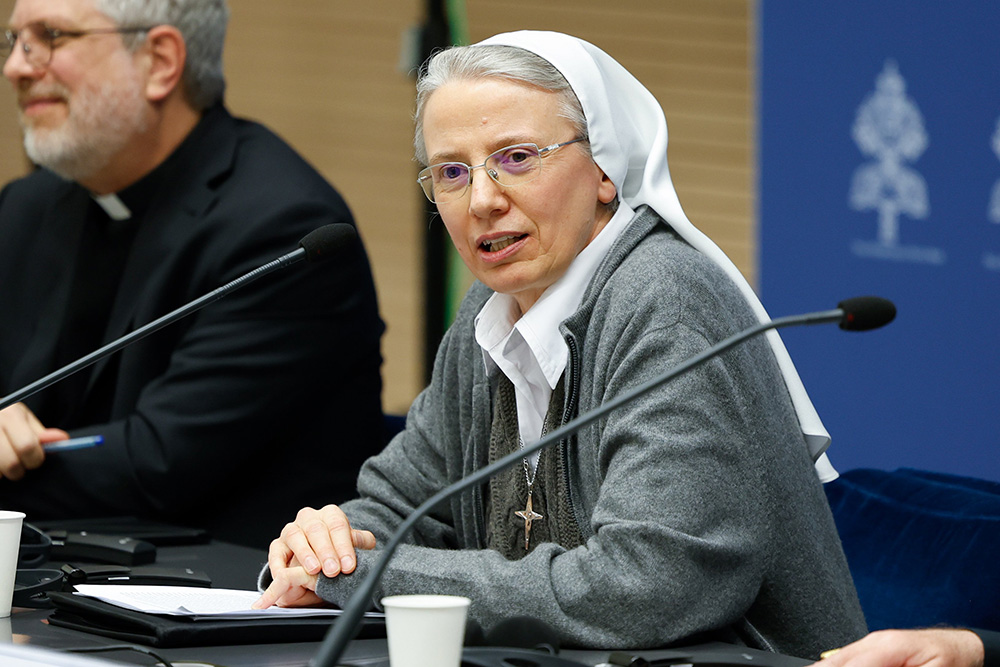
Consolata Missionary Sr. Simona Brambilla was appointed prefect of the Dicastery for Institutes of Consecrated Life and Societies of Apostolic Life, on Jan. 6. She is pictured here speaking at a news conference at the Vatican March 14, 2024, about study groups authorized by Pope Francis to examine issues raised at the synod on synodality. (CNS/Lola Gomez)

Consolata Missionary Sr. Simona Brambilla was appointed prefect of the Dicastery for Institutes of Consecrated Life and Societies of Apostolic Life, on Jan. 6. She is pictured here speaking at a news conference at the Vatican March 14, 2024, about study groups authorized by Pope Francis to examine issues raised at the synod on synodality. (CNS/Lola Gomez)

by Christopher White

Former Vatican Correspondent (2021-2025)

View Author Profile

Join the Conversation

Send your thoughts to Letters to the EditorLearn more

Pope Francis on Jan. 6 appointed the first ever female to lead a Vatican department, continuing an ongoing trend of this pontificate to place more women in leadership in the Catholic Church. 

Consolata Missionary Sr. Simona Brambilla will serve as prefect of the Dicastery for Institutes of Consecrated Life and Societies of Apostolic Life, the Vatican office that works with religious orders and their members.

The announcement comes three years after Francis formally overhauled the Vatican's constitution allowing for women and laity to offices of the Roman Curia. 

The appointment also comes at the conclusion of the pope's global synod process, which acknowledged that "women continue to encounter obstacles in obtaining a fuller recognition … in all the various areas of the church's life."  Even so, critics have countered that there are still too few concrete efforts to promote women in positions in authority in church life. 

Advertisement

Brambilla, 59, is an Italian-born missionary and nurse who previously served in Mozambique. She also holds a doctorate in psychology from Rome's Gregorian University. 

In 2023, she was appointed as the department's secretary, marking the first time in Vatican history that a woman was named the number two official of the curia. Previously, she had served as an external member of the department. 

Also appointed on Jan. 6 was Salesian Cardinal Ángel Fernández Artime, 65, who will serve as the pro-prefect of the dicastery, the office's number two official. The office oversees nearly 700,000 consecrated women and men from religious orders around the globe. 

In her new role, Brambilla will now top a growing number of women that Francis has elevated to high ranking posts in the Vatican. Included in that number are Emilce Cuda, secretary of the Pontifical Commission for Latin America; Salesian Sr. Alessandra Smerilli, secretary of the Dicastery for Promoting Integral Human Development; and Xaviere Sr. Nathalie Becquart, who is the under-secretary of the Vatican's synod office. 

In the immediate wake of Brambilla's appointment, Becquart — who has become one of the most visible public faces of the synod — took to social media to celebrate the announcement: "Wonderful news!," she wrote.