2025 ജൂൺ 10, ചൊവ്വാഴ്ച

How the Global Religious Landscape Changed From 2010 to 2020

How the Global Religious Landscape Changed From 2010 to 2020

Muslims grew fastest; Christians lagged behind global population increase

How we did this

The world’s population expanded from 2010 to 2020, and so did most religious groups, according to a Pew Research Center analysis of more than 2,700 censuses and surveys.

Christians remained the world’s biggest religious group. But Christians (of all denominations, counted as one group) did not keep pace with global population growth from 2010 to 2020.

Bar chart showing that Christians are the world’s largest religious group
  • The number of Christians rose by 122 million, reaching 2.3 billion.
  • Yet, as a share of the world’s population, Christians fell 1.8 percentage points, to 28.8%.

Muslims were the fastest-growing religious group over the decade.

  • The number of Muslims increased by 347 million – more than all other religions combined.
  • The share of the world’s population that is Muslim rose by 1.8 points, to 25.6%.
Bar chart showing Muslims were the fastest-growing religious group between 2010 and 2020

Buddhists were the only major religious group that had fewer people in 2020 than a decade earlier.

  • The number of Buddhists worldwide dropped by 19 million, declining to 324 million.
  • As a share of the global population, Buddhists slipped by 0.8 points, to 4.1%.

People with no religious affiliation – who are sometimes called “nones” – were the only category aside from Muslims that grew as a percentage of the world’s population.1
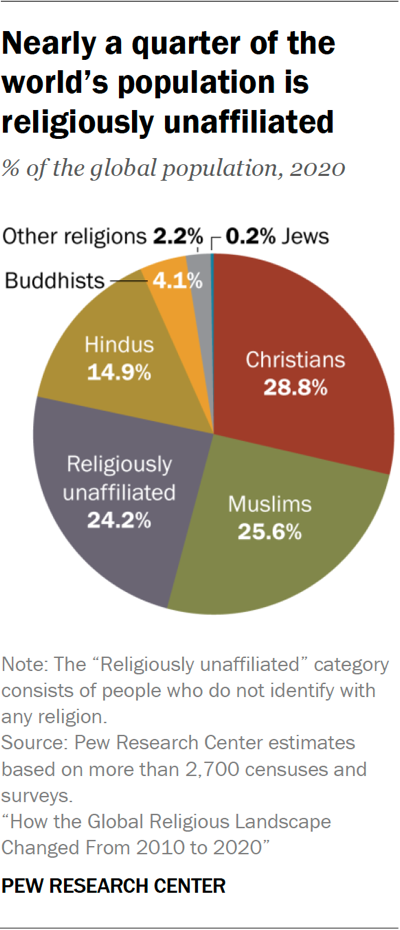
Pie chart showing nearly a quarter of the world’s population is religiously unaffiliated
  • The number of religiously unaffiliated people rose by 270 million, reaching 1.9 billion.
  • The share of “nones” climbed nearly a full percentage point, to 24.2%.

Hindus grew at about the same rate as the world’s overall population.

  • The number of Hindus rose by 126 million, reaching 1.2 billion.
  • As a proportion of the global population, Hindus held steady at 14.9%.

Jews also held steady as a share of the world’s population.2

  • The number of Jews worldwide grew by nearly 1 million, reaching 14.8 million.
  • In percentage terms, Jews were the smallest group in the study, representing about 0.2% of the world’s population.

All other religions combined (including Baha’is, Daoists, Jains, Sikhs, adherents of folk religions and numerous other groups) expanded in tandem with the rest of the world. Their share of the global population held steady at 2.2%.

Collectively, 75.8% of the world’s people identified with a religion as of 2020. The remaining 24.2% did not identify with any religion, making people with no religious affiliation the third-largest group in this study, after Christians and Muslims.

Since 2010, the share of the global population that has any religious affiliation has declined by nearly 1 percentage point (from 76.7%) while the share without an affiliation has risen by the same amount (from 23.3%).

The growth of religious “nones” is striking because they are at a “demographic disadvantage” – their population is relatively old, on average, with relatively low fertility rates. However, unaffiliated people continued to grow as a share of the global population because many affiliated people around the world – primarily Christians – are “switching” out of religion.

How religious ‘nones’ grew despite their demographic disadvantage

Regional change

Between 2010 and 2020, the share of the global population living in sub-Saharan Africa increased to 14.3% (up 2 percentage points), and the share living in the Middle East-North Africa region rose to 5.6% (up 0.5 points).

Line chart showing sub-Saharan Africa has surpassed Europe to become the region where the most Christians live

Every other region held a smaller share of the world’s population in 2020 than in 2010. These shifts are reflected in the geographic distribution of some religious groups, including Christians.

Sub-Saharan Africa is now home to the largest number of Christians, surpassing Europe. As of 2020, 30.7% of the world’s Christians live in sub-Saharan Africa, compared with 22.3% in Europe. This change was fueled by differences in the two regions’ rates of natural increase (with much higher fertility rates in Africa than in Europe), as well as by widespread Christian disaffiliation in Western Europe.

The regional concentration of Jews also has changed. As of 2020, 45.9% of Jews live in the Middle East-North Africa region, while 41.2% reside in North America. In 2010, North America was the region where the largest number of Jews lived. This shift was primarily the result of Israel’s Jewish population growing from 5.8 million to 6.8 million between 2010 and 2020, through a combination of natural increase and migration.5

Changes within countries

Another way to assess religious change is to look at how many countries and territories experienced a substantial shift in their religious makeup. In this section, we focus on places where a religious group’s share of the overall population grew or shrank by at least 5 percentage points between 2010 and 2020. (For a discussion of the challenge of measuring the statistical significance of changes in religious composition, refer to the Methodology.)
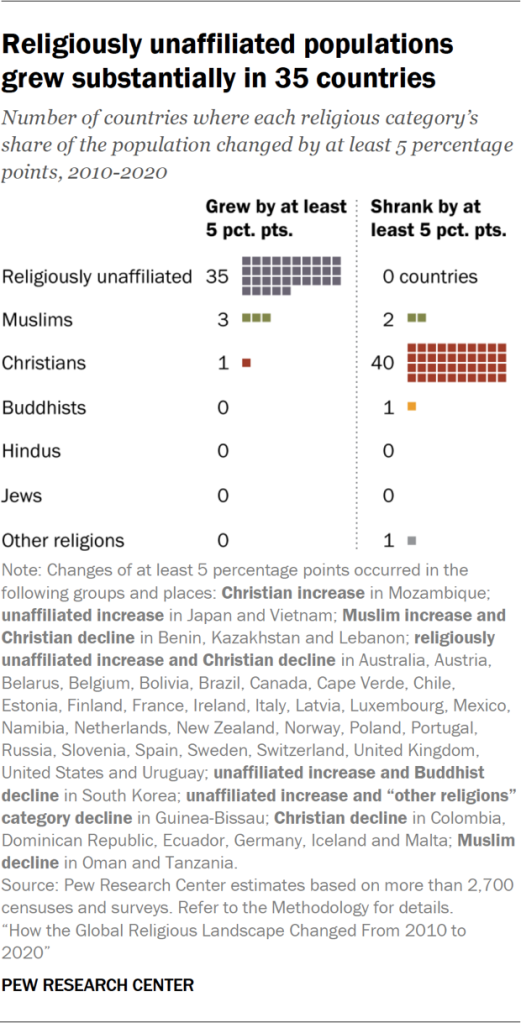
Chart showing religiously unaffiliated populations grew substantially in 35 countries

Christians experienced a substantial change, as defined above, in more countries (41) than any other religious group. In all but one case, Christians shrank as a share of the population. Most of the countries experiencing declines were in the Americas and Europe. The decreases ranged from a 5-point drop in Benin to a 14-point drop in the U.S. and a 20-point drop in Australia.

Only in Mozambique did the share of the population that is Christian grow substantially between 2010 and 2020, rising by 5 percentage points.

Few countries experienced substantial changes in the percentage of Muslims in their populations. Although the global Muslim population grew at a faster rate than any other major religion between 2010 and 2020, this was largely because of overall population growth in the countries where Muslims are concentrated. Muslim shares are estimated to have risen by at least 5 points in Kazakhstan, Benin and Lebanon, and to have dropped by at least 5 points in Tanzania and Oman.

In addition, there were declines of 7 points in the Buddhist share of South Korea’s population and in the share that people of other religions made up of Guinea-Bissau’s population.

Religiously unaffiliated people experienced the largest number of substantial increases. People of no religion gained at least 5 percentage points in 35 countries spread across the globe. The unaffiliated grew the most (as a share of each country’s total population) in the U.S. (up 13 points), Uruguay (up 16 points), Chile (up 17 points) and Australia (up 17 points).

The United States, as of 2020, is the country with the world’s second-largest number of religiously unaffiliated people (after China), surpassing Japan.

Chart showing China has 7 times as many religiously unaffiliated people as the U.S. and Japan combined

The U.S. had roughly 101 million religious “nones” in 2020 (up 97% from a decade earlier), while Japan had 73 million (up 8%). However, the unaffiliated category continues to account for a much larger share of the total population in Japan – 57% of all Japanese are religiously unaffiliated – than in the U.S., where 30% identify as atheist, agnostic or “nothing in particular.”

In both 2010 and 2020, China had more religiously unaffiliated people than any other country. China’s 1.3 billion unaffiliated people made up 90% of its total population in 2020.6

Most countries still have Christian majorities

Due to disaffiliation from Christianity, there now are fewer Christian-majority countries and more countries with a religiously unaffiliated majority than there were in 2010.
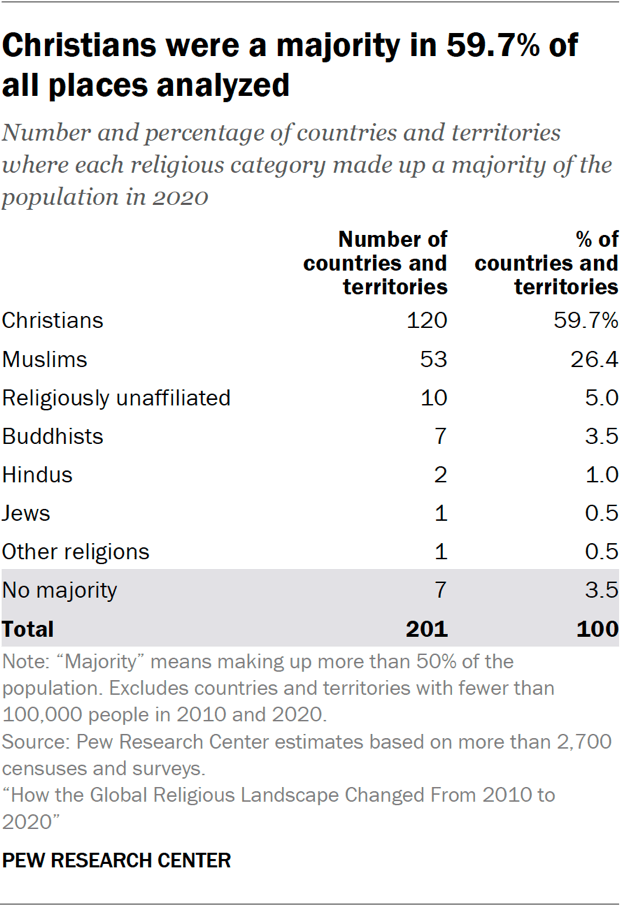
Table showing Christians were a majority in 59.7% of all places analyzed

As of 2020, Christians were a majority in 120 countries and territories, down from 124 a decade earlier. Christians dropped below 50% of the population in the United Kingdom (49%), Australia (47%), France (46%) and Uruguay (44%). In each of these places, religiously unaffiliated people now account for 40% or more of the population, and smaller religious groups such as Muslims, Hindus, Buddhists, Jews or adherents of other religions (combined) account for 11% or less.

Over the same period, religiously unaffiliated people became a majority in the Netherlands (54%), Uruguay (52%) and New Zealand (51%), raising the number of places with an unaffiliated majority from seven to 10. (These countries joined China, North Korea, the Czech Republic, Hong Kong, Vietnam, Macao and Japan, which already had religiously unaffiliated majorities in 2010.)

Table showing the Netherlands, New Zealand and Uruguay now have religiously unaffiliated majorities

There was no change in the number of places in which the majority of the population are Muslim (53), Buddhist (7), Jewish (1) or followers of other religions (1).7

These are among the key findings of a Pew Research Center of more than 2,700 censuses and surveys, including census data releases that were delayed due to the coronavirus pandemic. The study is part of the Pew-Templeton Global Religious Futures project, which seeks to understand global religious change and its impact on societies.

The rest of this Overview discusses: Why religious change occurred at the global level between 2010 and 2020; the connection between economic development and religious affiliation; religious groups’ geographic distributions and age profiles in 2020; and whether religious groups live as religious majorities or minorities within countries.

It concludes with an explanation of how and why we have revised our 2010 estimates and updated our methods for making demographic estimates.

Why change occurred at the global level

Global change in the size of religious populations is the result of two primary mechanisms: religious “switching” and natural increase (i.e., the difference between births and deaths). The latter is influenced by several demographic factors: age structure, fertility and mortality (or life expectancy).

How much change each mechanism creates varies by religion:

  • Religious disaffiliation is the main driver of the decline in the Christian share of the global population.
  • Religious disaffiliation – primarily of people leaving Christianity – also is the main driver of the growth of religiously unaffiliated populations.
  • Increases in the global Muslim population are largely due to Muslims having a relatively young age structure and high fertility rate, two characteristics that result in natural population growth.

In addition, migration is a source of religious change within some regions and countries. But migration does not affect religious group sizes at the global level (as long as people remain bound to this planet). For more about the regional and country-level impact of migration, read Chapter 1.

Religious ‘switching’

Although most people around the world still identify with the religion in which they were raised, religious switching is pervasive. Overall, there’s been a net movement of people switching into the religiously unaffiliated category.

This Pew Research Center study is the first to report on observed patterns of switching into and out of religious groups at the global level.8 In many countries, this change has followed a generational pattern: Each new generation of young adults has contained a larger share of people who are religiously unaffiliated, either because they were not raised in any religion or because they have switched away from the religion in which they were raised.

What is religious ‘switching’?

Many more people grew up with a religion than grew up with no religion. And most people, as adults, still identify with a religion. But the balance between the groups is changing.

Chart showing that worldwide, 3 adults have left a religion for every adult who has joined

Using surveys from 117 countries and territories, we analyzed data from adult respondents and compared the religion they say they were raised in (as children) with their current religious identity (as adults).9

To capture switching that has occurred in more recent years, we use data from adults ages 18 to 54. Religious switching is more common earlier in life, though it can happen at any age.

We found that for every adult in that age group who says they joined a religion after having been raised without a religion, 3.2 moved in the other direction – they left religion altogether after having been raised in one.

As a result, based on this set of measures, the religiously unaffiliated category has had the largest net gain due to switching.

Christians have experienced the biggest net losses from switching (3.1 have left for every 1.0 who has joined). Most former Christians no longer identify with any religion, but some now identify with a different religion.

Buddhists also have had more people leave than join (1.8 left, 1.0 joined).

Hindus have had more people leave than join, while the reverse is true for Muslims. However, religious switching into or out of these two groups is relatively uncommon, so the modest differences in the ratio of leavers to joiners has a small overall effect on the size of Hindu and Muslim populations.

For more details about religious switching, read Chapter 1.10

Religious ‘switching’ out of Christianity in the United States

Natural increase

Natural population growth – the extent to which births outnumber deaths – is greater for religious groups that have higher fertility rates and lower mortality rates.

In a report published in 2017, we modeled the number of births and deaths that occurred globally between 2010 and 2015. We estimated that Muslims gained the most via natural increase, followed by Christians. By contrast, natural growth among the religiously unaffiliated was modest.

Groups’ varied rates of natural increase are partly the result of geographic distribution. Religions that are concentrated in parts of the globe with relatively high overall population growth (such as the Middle East-North Africa region and sub-Saharan Africa) naturally would expand more quickly than those concentrated in low-growth regions (such as North America, the Asia-Pacific region and Europe).

Muslims and Christians have a large presence in the rapidly growing region of sub-Saharan Africa, but many Christians also live in the slower-growth regions of Europe and the Americas. Religiously unaffiliated people and Buddhists are heavily concentrated in countries that have shrunk as a share of the world’s population, including China and Japan.

Nevertheless, religious differences sometimes appear to play a role in fertility, even after accounting for geography. For example, Nigerian Muslims have a higher average birth rate than Nigerian Christians, and Hindus in India have a higher fertility rate than Buddhists in India. These differences also may be related to other factors, such as education, access to birth control and women’s workforce participation rates.

For more details about natural growth patterns, read Chapter 1.

Economic development and religious affiliation

People in wealthier parts of the world are, on average, less religious than those in societies with less advanced economies. This pattern holds true across many different measures of religion – such as rates of daily prayer and belief in god – and across many indicators of economic development. For example, Pew Research Center in 2018 found that people in countries with higher life expectancy at birth are less likely to attend religious services weekly.11

To get a more general sense of this pattern, it helps to look at country scores on the United Nations’ Human Development Index (HDI), which combines data on life expectancy, education and income.

We find that countries with high HDI scores (i.e., those that are more developed) tend to have lower rates of religious affiliation. In many of these countries, Christianity is the most common religion. In a few Asian countries with high HDI scores and low affiliation rates, Buddhism is the largest religion. In some countries, the religiously unaffiliated category is approaching or already exceeds the largest religious group in size.

Countries with low HDI scores, on the other hand, tend to have high rates of religious affiliation.

Economic development is not perfectly correlated with religion, and there are some countries with high rates of religious affiliation across the range of HDI scores. This includes many Muslim-majority countries, Hindu-majority India and Nepal, and Jewish-majority Israel.

Chart showing economically advanced countries tend to have smaller shares of religiously affiliated people

Geographic distribution of religious groups in 2020

Nearly six-in-ten people worldwide live in the Asia-Pacific region, including most people in five religious categories: 99% of Hindus, 98% of Buddhists, 78% of the religiously unaffiliated, 65% of followers of other religions, and 59% of Muslims.

Christians are the most geographically dispersed group. The largest share of Christians live in sub-Saharan Africa (31%), followed by the Latin America-Caribbean region (24%) and Europe (22%). This is a major geographic change since the early 1900s, when Christians in sub-Saharan Africa made up 1% of the global Christian population and two-thirds of Christians lived in Europe.

Most Jews live either in the Middle East-North Africa region or in North America.
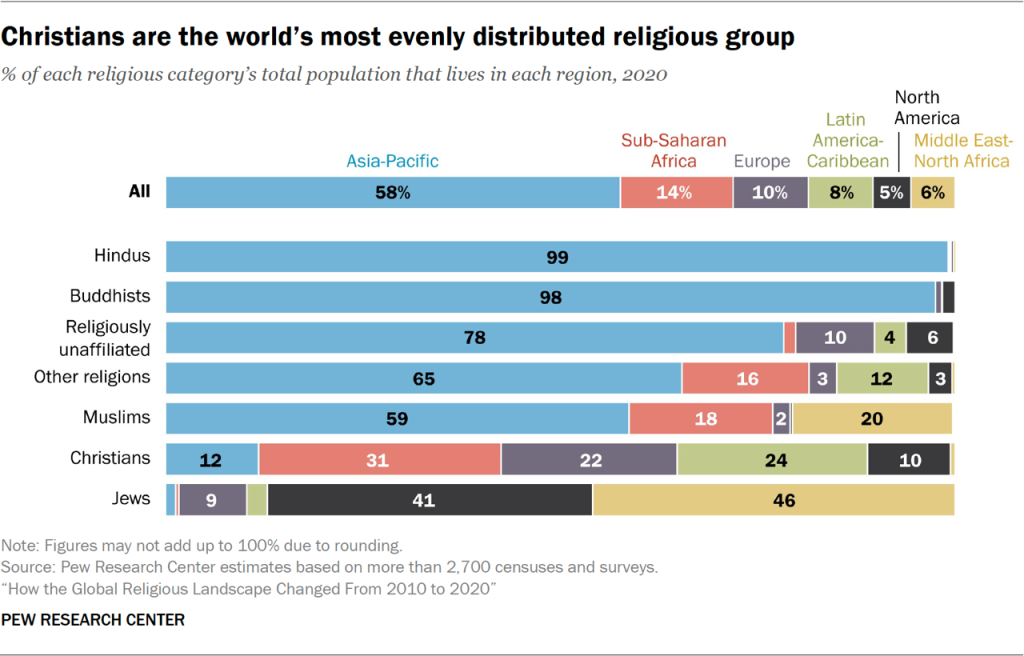
Bar chart showing Christians are the world’s most evenly distributed religious group

Age profile of religious groups in 2020

As of 2020, Muslims have the highest proportion of children in their population (33% of all Muslims worldwide are under 15). Jews and Buddhists have the highest proportion of older adults; 36% in each group are ages 50 and older.

Much of the variation in the age structure of religious groups is driven by their geographic concentration. For example, about half of the world’s Jews live in North America and Europe, regions that have relatively old populations.

The youthfulness of Muslims is tied to the fact that nearly four-in-ten of the world’s Muslims live in sub-Saharan Africa and the Middle East-North Africa region – places with relatively young populations.

Bar chart showing the vast majority of Muslims around the world are younger than 50

Christians have a large presence in many regions, from the most youthful (sub-Saharan Africa) to the least (Europe). Among religious groups, Christians have the median age (30.8 years) closest to the world’s overall median age (30.6).

If religious groups are heavily clustered in just one country, their global age structure reflects that country’s characteristics. For instance, the global age distribution of Hindus mirrors the age distribution of India, which is home to 95% of the world’s Hindus. Similarly, the age profile of religiously unaffiliated people resembles that of China, which is home to 67% of all unaffiliated people.

Table showing Buddhists are older than other religious groups, with a median age of 39.8 years

Do people mostly live as religious majorities or minorities?

Around the world, 80% of all people live in a place in which most other people share their religious identity. People living as a religious minority in their country make up 20% of the world’s population.

This analysis does not divide the seven major religious categories into subgroups, so Protestants living in Catholic-majority countries or Shiite Muslims living in Sunni-majority countries, for example, are considered to be living in a place where their broader faith is in the majority.

Bar chart showing 84% of Christians live in places where Christianity is the majority religion

Hindus are most likely to live as a religious majority, with 97% living in the world’s two Hindu-majority countries, India and Nepal. About eight-in-ten Muslims are part of a religious majority, as are similar shares of Christians and religiously unaffiliated people. Slightly fewer than half of all Buddhists and Jews live as a majority.

The world’s seven Buddhist-majority countries (Cambodia; Thailand; Myanmar, also known as Burma; Bhutan; Sri Lanka; Laos; and Mongolia) are home to 47% of all Buddhists. Israel, the sole Jewish-majority country, is home to 46% of all Jews. Taiwan is the only place where members of other religions are in the majority, and 7% of all people in the “other religion” category, worldwide, live in Taiwan. (Many Taiwanese people practice Daoism and traditional folk religions. Read more about Taiwan’s religious beliefs and practices in our report “Religion and Spirituality in East Asian Societies.”)

Revising previous estimates

The 2010 estimates in this report differ from what we have published in the past. We adjusted our data sources and methods to make our estimates for 2010 and 2020 as reliable and comparable as possible.

Most consequentially, we changed how we measure China’s religious composition. In the past, we used custom estimates for China to adjust for the fact that surveys in China often do not fully capture people’s religious identity. This report relies on measures of zongjiao religious identity, as these are the most comparable with what we use in every other country, as well as the most readily comparable over time in China. (The measure of formal zongjiao religious identity commonly used in Chinese surveys excludes people who engage in religious or spiritual beliefs and practices but do not consider themselves affiliated with any religion.)

According to our new approach, 10% of China’s population identified with a religion in 2020, the lowest share of any country in the study. Since China has such a large population, this new approach has increased our estimate of the religiously unaffiliated share of the world’s population.

Read more about the challenges of measuring religion in China in our 2023 report. More information about improvements in our methodology is available in Chapter 15 and in the Methodology.

Recommended Citation:

Conrad Hackett, Marcin Stonawski, Yunping Tong, Stephanie Kramer, Anne Shi and Dalia Fahmy. “How the Global Religious Landscape Changed From 2010 to 2020”. Pew Research Center. doi: 10.58094/fj71-ny11

  1. The “Religiously unaffiliated” category includes people who say they are atheist, agnostic or “nothing in particular” in response to a Pew Research Center survey question about religious identity, as well as people who choose a “No religion” or “None” option in other surveys and national censuses. While they do not identify with any religion, some religiously unaffiliated people do hold religious or spiritual beliefs and engage in religious or spiritual practices – though typically at lower levels than are found among people in the same country who have a religious affiliation. For details, read our 2024 report “Religious ‘Nones‘ in America: Who They Are and What They Believe” and our 2018 report “Being Christian in Western Europe.”
  2. Outside of Israel, we generally use a definition of Jewishness based on self-identification with Judaism as a religion. Our estimate for Israel is based on the government’s population register of Jews in Israel, which only counts people as Jewish if they meet halakhic (religious) legal criteria – i.e., children of Jewish mothers as well as people who have undergone conversions recognized by the government.
  3. At the global level, religiously unaffiliated people are older than affiliated people, on average. However, at the country level, the opposite pattern is often true. The unaffiliated are younger than the affiliated in China, Japan and most countries in Europe and the Americas, including the United States. This pattern reversal is an example of a mathematical phenomenon called Simpson’s paradox. Because China and Japan have such large populations, their age patterns have a big influence on global averages. Both countries have unaffiliated majorities and high median ages.
  4. Terms such as “conversion,” “reversion” and “apostasy” also are sometimes used to describe the choice to enter or leave a religious group. We use the term “switching” because the movement can take place in all directions, including leaving religion entirely, and does not necessarily involve any formal ritual.
  5. The size of the Jewish populations in Israel and North America depends on the definition of Jewishness. For more information, jump to Chapter 8.
  6. The population of religiously unaffiliated people in China (as in other countries) includes some people who engage in activities and hold beliefs that can be considered religious or spiritual, even though they don’t describe themselves as belonging to any religion. For more about the unaffiliated in China, refer to our report “Measuring Religion in China.”
  7. Taiwan is the only place in which the “other religions” category constitutes a majority. This reflects large numbers of Daoists and practitioners of Chinese folk religions in Taiwan.
  8. This report is the first to provide global estimates of religious switching. Several previous Pew Research Center reports have described country-level patterns of religious switching. For example, “Around the World, Many People Are Leaving Their Childhood Religions” reports on switching patterns in 36 countries.
  9. We weighted data by each place’s population size in 2010 so that countries and territories with larger populations of each group have more influence on the global results for that group. These 117 surveys are from places that were home to 92% of the world’s 18- to 54-year-olds in 2010. For more details, read the Methodology.
  10. Chapter 1 discusses the challenges of measuring religious switching among Jews and among the “other religions” category.
  11. A popular theory is that rising economic and existential security leads to religious decline. Studies have tested and developed this theory in many contexts. For an overview of this literature, read Molteni, Francesco. 2024. “Rising Security and Religious Decline: Refining and Extending Insecurity Theory.” Sociology of Religion.
Icon for promotion number 1


2025 മേയ് 17, ശനിയാഴ്‌ച

The Canons of the Council of Nicea

The Canons of the Council of Nicea

The Council of Nicea met in A.D. 325 to address the doctrines of Arius, that were spreading with the help of Eusebius, the bishop of Nicomedia (not to be confused with Eusebius the historian).

At the bottom of The Trinity page you will find the links to the 6-page series on the Trinity.

The study I put into these articles has resulted in a book called Decoding Nicea. Often reviewed as "interesting," it tells the story of Nicea in more detail than is possible here. Available wherever books are sold. See Amazon reviews.

Arius' doctrine that the Son of God was created in the beginning, rather than begotten of God's own substance, was rejected and condemned at Nicea. The council drew up a short creed summing up Christian belief and specifically condemning Arius' belief.

The council had other, lesser issues to address as well. Their decisions were given in a series of "canons," or rules, which are not so well-known as the creed.

These canons are found in The Nicene and Post-Nicene Fathers, series 2, vol. XIV.

The Twenty Canons of Nicea

Canons: | 1 | 2 | 3 | 4 | 5 | 6 | 7 | 8 | 9 | 10 |11 | 12 | 13 | 14 | 15 | 16 | 17 | 18 | 19 | 20 | 

Canon 1

If any one in sickness has been subjected by physicians to a surgical operation, or if he has been castrated by barbarians, let him remain among the clergy; but, if any one in sound health has castrated himself, then it is good that such a one, if enrolled among the clergy, should cease, and that from henceforth no such person should be promoted† But, as it is evident that this is said of those who wilfully do the thing and presume to castrate themselves, so if any have been made eunuchs by barbarians, or by their masters, and should otherwise be found worthy, such men the Canon admits to the clergy.

Comments:

This simply says that no one who is a eunuch—castrated— by his own design may remain a bishop or elder. Also, in the future, no one should be appointed elder who is castrated by their own will.

Why would someone do this? In the early church, remaining a virgin your whole life was greatly honored.

It was this focus—in my opinion borrowed from Greek ascetic philosophies, not from the apostles—that would eventually lead to all bishops and elders being required to take a vow of chastity.

Canon 2

Forasmuch as, either from necessity, or through the urgency of individuals, many things have been done contrary to the Ecclesiastical canon, so that men just converted from heathenism to the faith, and who have been instructed but a little while, are straightway brought to the spiritual laver, and as soon as they have been baptized, are advanced to the episcopate [office of bishop] or the presbyterate [office of elder], it has seemed right to us that for the time to come no such thing shall be done. For to the catechumen himself there is need of time and of a longer trial after baptism. For the apostolical saying is clear, "Not a novice; lest, being lifted up with pride, he fall into condemnation and the snare of the devil." But if, as time goes on, any sensual [lit., "soulish"] sin should be found out about the person, and he should be convicted by two or three witnesses, let him cease from the clerical office. And whoso shall transgress these [enactments] will imperil his own clerical position, as a person who presumes to disobey the great Synod.

Comments:

Basically, this requires that a person have an unspecified amount of experience before being promoted to elder or bishop.

Strangely, it adds that if he's found in "any sensual sin," then he needs to be dismissed from his office. Several suggestions have been made for what this means:

  • If a bishop or elder commits sexual sin, he should be removed. (Why would this need to be specified?)
  • If a bishop or elder that's been appointed too soon commits sexual sin, he should be removed. (Again, why specify this? All leaders who commit sexual sin would have been removed in the 4th century.)
  • If a bishop or elder that's been appointed too soon is found to have committed a grievous sin prior to becoming a leader, then he should be removed. (This doesn't really fit the text, which seems to suggest future sin, not past sin.)

None of these are very satisfying. As far as I know, it's still debated what this means.

Canon 3

The great Synod has stringently forbidden any bishop, presbyter, deacon, or any one of the clergy whatever, to have a subintroducta dwelling with him, except only a mother, or sister, or aunt, or such persons only as are beyond all suspicion.

Comments:

A "subintroducta" would be a person—in this case, female—brought into a leader's house for the purpose of discipleship.

Apparently, this practice, a common problem in the Middle Ages, was already happening in the early 4th century. This is very sad.

Canon 4

It is by all means proper that a bishop should be appointed by all the bishops in the province; but should this be difficult, either on account of urgent necessity or because of distance, three at least should meet together, and the suffrages of the absent [bishops] also being given and communicated in writing, then the ordination should take place.† But in every province the ratification of what is done should be left to the Metropolitan.

Comments:

A Metropolitan is a bishop that is over a city and surrounding towns that have multiple congregations.

This canon says that a bishop should have the approval of all the bishops in a province. Cyprian had said this 75 years earlier (see Leadership Quotes), so this is not new.

Canon 5

Concerning those, whether of the clergy or of the laity, who have been excommunicated in the several provinces, let the provision of the canon be observed by the bishops which provides that persons cast out by some be not readmitted by others. Nevertheless, inquiry should be made whether they have been excommunicated through captiousness, or contentiousness, or any such like ungracious disposition in the bishop. And, that this matter may have due investigation, it is decreed that in every province synods shall be held twice a year, in order that when all the bishops of the province are assembled together, such questions may by them be thoroughly examined, that so those who have confessedly offended against their bishop, may be seen by all to be for just cause excommunicated, until it shall seem fit to a general meeting of the bishops to pronounce a milder sentence upon them. And let these synods be held, the one before Lent, (that the pure Gift may be offered to God after all bitterness has been put away), and let the second be held about autumn.

Comments:

What this covers is plain. Those excommunicated in one church should not be readmitted in another. If there's questions about the excommunication, the bishops should talk to one another. In order to facilitate that, there will be synods held twice a year in each province.

You may notice that there's an official "Lent" here. That's a very early practice. Irenaeus mentions differences in various churches over how long they fasted prior to Passover (it wasn't "Easter" until later) already in A.D. 185 (Eusebius, Ecclesiastical History V:24).

Canon 6

Let the ancient customs in Egypt, Libya and Pentapolis prevail, that the Bishop of Alexandria have jurisdiction in all these, since the like is customary for the Bishop of Rome also. Likewise in Antioch and the other provinces, let the Churches retain their privileges. And this is to be universally understood, that if any one be made bishop without the consent of the Metropolitan, the great Synod has declared that such a man ought not to be a bishop. If, however, two or three bishops shall from natural love of contradiction, oppose the common suffrage of the rest, it being reasonable and in accordance with the ecclesiastical law, then let the choice of the majority prevail.

Comments:

This is an important canon!!!

To say the least.

This says that the bishop of Alexandria has far more authority than a Metropolitan (mentioned in canon 4). He has authority over all of Egypt, Libya, and the Pentapolis. Then it says that the bishop of Rome has a similar jurisdiction.

It doesn't express the extent of that jurisdiction, but it seems certain that the pope's claim to be the leader of the Church in the whole world is contradicted by canon 6 of Nicea.

This canon is considered to have created the first official "patriarchs." To this day the bishops of Antioch, Alexandria, and Rome—the ones mentioned in this canon—are the heads of the various Orthodox churches. Others, like the bishop of Constantinople and Moscow have been added in the centuries since.

Canon 7

Since custom and ancient tradition have prevailed that the Bishop of Ælia [i.e., Jerusalem] should be honoured, let him, saving its due dignity to the Metropolis, have the next place of honour.

Comments:

This canon adds patriarchal dignity (see comments on canon 6) to the bishop ot Jerusalem, even though he doesn't have the same wide range of authority as the metropolitans mentioned in canon 6.

Canon 8

Concerning those who call themselves Cathari, if they come over to the Catholic and Apostolic Church, the great and holy Synod decrees that they who are ordained shall continue as they are in the clergy. But it is before all things necessary that they should profess in writing that they will observe and follow the dogmas of the Catholic and Apostolic Church; in particular that they will communicate with persons who have been twice married, and with those who having lapsed in persecution have had a period [of penance] laid upon them, and a time [of restoration] fixed so that in all things they will follow the dogmas of the Catholic Church. Wheresoever, then, whether in villages or in cities, all of the ordained are found to be of these only, let them remain in the clergy, and in the same rank in which they are found. But if they come over where there is a bishop or presbyter of the Catholic Church, it is manifest that the Bishop of the Church must have the bishop's dignity; and he who was named bishop by those who are called Cathari shall have the rank of presbyter, unless it shall seem fit to the Bishop to admit him to partake in the honour of the title. Or, if this should not be satisfactory, then shall the bishop provide for him a place as Chorepiscopus, or presbyter, in order that he may be evidently seen to be of the clergy, and that there may not be two bishops in the city.

Comments:

The Cathari, or "the pure," are the Novatianists, not to be confused the Cathari of the late middle ages.

The Novatianists were started by an elder named Novatian around A.D. 250 in Rome. Novatian objected to the forgiveness of those who lapsed during persecution. The churches did not agree with him, so he found three bishops willing to ordain him a bishop, and he formed his own schism.

The Novatianists and Montanists were the only pre-Nicene schisms in the church except the gnostics, who cannot be called Christians.

Novatianist doctrine was exactly the same as the catholic (universal) churches except for refusing forgiveness to those who lapsed during persecution. They also would not take communion with any who were divorced and remarried as Christians. (Many would disagree with me, but it seems quite obvious that divorce and remarriage prior to becoming a Christian was ignored by the Church. See quotes by Tertullian on this page.)

This canon allows Novatianist clergy to leave the Novatianists and keep their status as elder or bishop, though the catholic bishop would have priority where there was conflict.

A Chorepiscopus is a bishop of a small congregation that is also under the supervision of a Metropolitan (see canon 4 comments). The office was invented in the late 3rd century and ceased to be used in the 9th.

Canon 9

If any presbyters have been advanced without examination, or if upon examination they have made confession of crime, and men acting in violation of the canon have laid hands upon them, notwithstanding their confession, such the canon does not admit; for the Catholic Church requires that which is blameless.

Comments:

The examination mentioned here is not a written test, but a questioning done by other bishops.

Some of the more heinous sins (blasphemy, bigamy, heresy, idolatry, etc.) made a person uneligible for leadership in the Church. This canon says that churches have to check for these things, and that anyone who was not examined or who was wrongly ordained must be removed from office.

The argument used for such rules came from passages like Lev. 21:17-18, where God tells Moses and Aaron that no one with a blemish can approach the altar of God.

Canon 10

If any who have lapsed have been ordained through the ignorance, or even with the previous knowledge of the ordainers, this shall not prejudice the canon of the Church; for when they are discovered they shall be deposed.

Comments:

If a person denied Christ or offered sacrifice to the Roman gods during persecution, he is never to be a church leader. If he is already ordained for some reason, he shall be deposed.

Canon 11

Concerning those who have fallen without compulsion, without the spoiling of their property, without danger or the like, as happened during the tyranny of Licinius, the Synod declares that, though they have deserved no clemency, they shall be dealt with mercifully. As many as were communicants, if they heartily repent, shall pass three years among the hearers; for seven years they shall be prostrators; and for two years they shall communicate with the people in prayers, but without oblation.

Comments:

For those that are used to a purely Biblical—or even purely apostolic—Christianity, there are a lot of new words here. These all resulted from the Church having to learn how to deal with situations of church discipline.

Basically, if you denied Christ or offered sacrifice, and the persecutors didn't have to hurt you or take your property to get you to do so, there's a long path of discipline to go through before you are admitted to communion. The canon even mentions that you wouldn't deserve even that (which is true), but the Church is being merciful.

In 4th century congregations, people sat in sections. There were those admitted to communion; there were those learning the basics of the faith in preparation for baptism, called catechumens; there were hearers, who had made no decision to continue as Christians but were considering; and there were penitents, or prostrators as they are called here, who are forbidden from communion in penance for something they did.

This canon requires those who lapsed without having to be compelled to sit with the hearers for three years, the penitents for seven years, and then they could pray with the rest of the congregation but not take communion.

That may seem harsh, as it adds up to 12 years, but such people need to be grateful they're admitted to the church at all.

An oblation is a sacrifice, and the early church thought of communion as a sacrifice. They often called it the eucharist, which has a very Roman Catholic connotation nowadays, but really just means "thanksgiving," which is an awesome name.

Canon 12

As many as were called by grace, and displayed the first zeal, having cast aside their military belts, but afterwards returned, like dogs, to their own vomit, (so that some spent money and by means of gifts regained their military stations); let these, after they have passed the space of three years as hearers, be for ten years prostrators. But in all these cases it is necessary to examine well into their purpose and what their repentance appears to be like. For as many as give evidence of their conversions by deeds, and not pretence, with  fear, and  tears, and perseverance, and good works, when  they have  fulfilled  their appointed  time as hearers, may properly communicate  in prayers; and after that the bishop may determine yet more favourably concerning them. But those who take [the matter] with indifference, and who think the form of [not] entering the Church is sufficient for their conversion, must fulfil the whole time.

Comments:

I have had to replace my comments here because they were wrong. It had always surprised me that Constantine, who led the Council of Nicea, would allow a canon that forbids military service. Under his reign, much of the Roman empire became "Christian," at least in name. I have read estimates that up to 90% of the Roman empire was Christian by the end of Constantine's reign. How could Constantine defend his empire if 90% of his citizens refused to fight?

Apparently, Canon 12 is directed toward those that were in the army under Constantine's co-emperor Licinius. When the civil war started (or perhaps before), he required his army to sacrifice to the pagan gods. Some Christians left the army rather than sacrifice. Those who stayed and sacrificed were considered lapsed from the faith, just as all those who sacrifice under persecution are considered lapsed. Some, though, who left changed their mind and returned. Some of those even bought their way back into Licinius' army. After Licinius lost the civil war, those in his army wanted back into the Church. After all, it was the emperor who supported Christianity who won the civil war. 

Canon 12 deals with this situation, not Christians joining Constantine's army.

Again, this is a retraction. (I am writing July 3, 2018.) I did not know about this until challenged (secondhand) by a Facebook acquaintance that converted to Orthodoxy (William Leary). I got the information above from the notes on Canon 12 in The Nicene and Post-Nicene Fathers, series 2, vol. XIV, p.65 of my PDF version. You can read the notes on ccel.org.

Canon 13

CONCERNING the departing, the ancient canonical law is still to be maintained, to wit, that, if any man be at the point of death, he must not be deprived of the last and most indispensable Viaticum. But, if any one should be restored to health again who has received the communion when his life was despaired of, let him remain among those who communicate in prayers only. But in general, and in the case of any dying person whatsoever asking to receive the Eucharist, let the Bishop, after examination made, give it him.

Comments:

The Viaticum is a last rite. The editors of The Nicene and Post-Nicene Fathers say that it applies to "everything that could be conducive to the happy death of the person concerned."

This canon makes provision for a person receiving the Eucharist even if he is going through the penance mentioned in the previous canons. However, if he (or she) then recovers from his illness, he is to be once again banned from communion.

Canon 14

Concerning catechumens who have lapsed, the holy and great Synod has decreed that, after they have passed three years only as hearers, they shall pray with the catechumens.

Comments:

If you're a catechumen [someone learning the basics of the faith in preparation for baptism] and you deny Christ or sacrifice during a persecution, you have to go listen with the hearers for three years before you are readmitted as a catechumen.

Canon 15

On account of the great disturbance and discords that occur, it is decreed that the custom prevailing in certain places contrary to the Canon, must wholly be done away; so that neither bishop, elder, nor deacon shall pass from city to city. And if anyone, after this decree of the holy and great Synod, shall attempt any such thing, or continue in any such course, his proceedings shall be utterly void, and he shall be restored to the Church for which he was ordained bishop or elder.

Comments:

This canon stopped bishops, elders, and deacons from moving from city to city. Such a situation had happened with Origen. He had taught while traveling in Caesarea, and the bishop of his home church, Alexandria, had objected, saying only elders can teach.

So the next time through, Caesarea ordained him as an elder. When the bishop objected to that, too (rightly, I'd assume, because this was a divisive thing to do), Origen simply remained in Caesarea as an elder there.

Canon 16

Neither elders, nor deacons, nor any others enrolled among the clergy, who, not having the fear of God before their eyes, nor regarding the ecclesiastical Canon, shall recklessly leave from their own church, ought [not] by any means to be received by another church; but every constraint should be applied to restore them to their own parishes; and, if they will not go, they must be excommunicated. And if anyone shall dare surreptitiously to carry off and in his own church ordain a man belonging to another, without the consent of his own proper bishop, from whom although he was enrolled in the clergy list he has seceded, let the ordination be void.

Comments:

Obviously, this applies to Origen's situation, mentioned in the comments on the last canon. This is simply punishment decreed for those who violate canon 15.

Canon 17

Forasmuch as many enrolled among the Clergy, following covetousness and lust of gain, have forgotten the divine Scripture, which says, "He hath not given his money upon usury," and in lending money ask the hundredth of the sum [note by NPNF editors: "as monthly interest"; I don't know how they know this], the holy and great Synod thinks it just that if after this decree any one be found to receive usury, whether he accomplish it by secret transaction or otherwise, as by demanding the whole and one half, or by using any other contrivance whatever for filthy lucre's sake, he shall be deposed from the clergy and his name stricken from the list.

Comments:

The early church believed that lending money at interest (usury) was a sin. Getting caught doing it, according to this canon, would get you removed from church leadership.

It's important to understand the context of this. American Christians often want to apply Christian commands to the government or to banks, which are secular institutions. The early churches knew that Christians are supposed to be family. They are supposed to share their resources (see 2 Cor. 8:13-15, for example).

But what Christians are commanded is not what secular institutions are commanded. The Scriptures guide Christians into obedience to God, not into social activism. Notice that the punishment for charging interest is removal from church leadership, not being taken to court. This is a church matter, not a civil one.

Canon 18

It has come to the knowledge of the holy and great Synod that, in some districts and cities, the deacons administer the eucharist to the elders, whereas neither canon nor custom permits that they who have no right to offer should give the Body of Christ to them that do offer. And this also has been made known, that certain deacons now touch the eucharist even before the bishops. Let all such practices be utterly done away, and let the deacons remain within their own bounds, knowing that they are the ministers of the bishop and the inferiors of the elders. Let them receive the eucharist according to their order, after the elders, and let either the bishop or the elder administer to them. Furthermore, let not the deacons sit among the elders, for that is contrary to canon and order. And if, after this decree, any one shall refuse to obey, let him be deposed from the diaconate.

Comments:

Somehow, I have a hard time believing that the council called by the apostles in Acts 15 would have called itself "the holy and great Synod." That's quite a pompous beginning to a canon, fit for kings but not for church leaders.

It's important not to confuse this council with apostolic authority. The apostles committed the faith to the churches "once for all" (Jude 3).

There is a lot of ungodly comments here about the importance of certain offices. Let me assure you, God is not impressed with such things, and he does not think they are okay. Everything in this canon is sin and offensive to Christ. Jesus rebuked those who loved titles and the best seats (Matt. 23:6-11).

Okay, having said that, let me also say that this canon would have been gibberish in 1st and 2nd century churches. They would have asked, "What are you talking about? Administer the eucharist??? What does that mean?"

In the earlier churches, the eucharist was a meal. Bread was served, not administered, and people didn't take note of who "touched" it first.

The word deacon is the Greek word for servant. It is wrong that Bible translators translate diakonos as deacon in 1 Timothy and Titus, when it's translated as servant all 30 other times it's used in the New Testament.

The deacons were the servants of the churches. Thus, they were the ones who served the bread and wine of communion (Justin Martyr, First Apology 67) to those who were at the meal. It would have been normal for them to serve the bishops, elders, and everyone else.

Only late in the 3rd century does the eucharist turn into a ceremony where it's some sort of privilege to hand a small piece of bread or a wafer into the hand or mouth of the recipient. This canon is one of the signs of the terrible state the church had fallen into.

I make no apologies for my complete lack of impartiality in my comments on this section. This sort of behavior infuriated Jesus in the Pharisees and led to his loudest and longest outcry against them (Matt. 23).

Nothing about this canon is good (cf. Matthew 23:6-12Mark 10:42-45)

Canon 19

Concerning the Paulianists who have flown for refuge to the Catholic Church, it has been decreed that they must by all means be rebaptized; and if any of them who in past time have been numbered among their clergy should be found blameless and without reproach, let them be rebaptized and ordained by the bishop [whichever is most local] of the catholic church; but if the examination should discover them to be unfit, they ought to be deposed. Likewise in the case of their deaconesses, and generally in the case of those who have been enrolled among their clergy, let the same form be observed. And we mean by deaconesses such as have assumed the habit, but who, since they have no imposition of hands, are to be numbered only among the laity.

Comments:

"Paulianists" is a reference to Paul of Samosata, who believed that Jesus did not pre-exist. He believed that the Logos came upon Jesus at his birth, and it was only through righteousness that Jesus achieved oneness with God. He was accused of heresy in A.D. 269 and removed from the office of bishop.

He found protection from a queen in Syria, however, and so he was able to continue teaching for a few years. His followers, obviously, still existed 60 years later.

This canon says they have to be rebaptized to be admitted to the catholic churches. Paulianist baptism was not to be accepted. If they were clergy in the Paulianist church, then they could be ordained after baptism into the catholic churches.

Deaconnesses are mentioned here, and the editors of The Nicene and Post-Nicene Fathers mention that "the duties of the deaconess are set forth in many ancient writings."

These duties almost exclusively had to do with women, and they were especially needed at baptism for the sake of modesty. Sometimes, though, they would instruct the female catechumens as well. They were never allowed to teach men.

It is likely that they were required to take a vow of chastity.

Canon 20

Forasmuch as there are certain persons who kneel on the Lordís Day and in the days of Pentecost, therefore, to the intent that all things may be uniformly observed everywhere (in every parish), it seems good to the holy Synod that prayer be made to God standing.

Comments:

In De Corona (ch. 3) Tertullian, around A.D. 200, says that the practice of praying while standing on Sunday and between Passover and Pentecost was a long-standing tradition. So this tradition predates Nicea by around two centuries, at least.

The reason for this is that the first day of the week and Passover were days to celebrate the resurrection. Since they were days of celebration, kneeling and fasting were forbidden. Tertullian seems to think those traditions were observed everywhere.

Obviously, they weren't, but the council is asking that those practices become universal.

There are many who believe, falsely, that the Council of Nicea instituted the observance of Sunday as the Lord's day. They did not. It's mentioned in Ignatius' Letter to the Magnesians mentions observing the Lord's day rather than the Sabbath in A.D. 110 and The Letter of Barnabas mentions the first day of the week in opposition to the Jewish Sabbath around A.D. 130 (possibly earlier).

The observance of the Lord's day and the avoidance of fasting and kneeling on the first day of the week is a very ancient tradition.

Conclusion

The Council of Nicea issued these twenty canons and a creed. There were also letters issued by Eusebius of Caesarea, by the council itself, and by Constantine. However, these introduce no new issues.